December 19, 1943
Alma-Ata
The Comic. Ironie
Egyptian
caricature—the oldest known to us—is (it seems) built on ambivalence, on a
discrepancy between its figurative and its phonetic side, which are often found
in a direct contradiction.
Take as example a
caricature of Cleopatra, in which a representation of an offering of a goose to
Cleopatra signals a welcoming salutation, while according to its
verbally-phonetic interpretation the same representation serves the verbal
expression: “Run along!”[i]
That is an example
of graphic irony—irony which
is built on the reversal of the intended
meaning.
(NB. Ironic
movement is also built on this principle: a respectful bending of the figure by
a sudden cheeky glance from underneath the brow.)
It is interesting
that the ambivalence is used much more clearly in the older type of irony: the
unity of the two contradictory terms on a purely formal plane—not as unity, but
rather as a superimposition [English in the original] of
mutually exclusive meanings.
Creation of form
was at first also objective and thing-like: a shape was “formed” by adding to
it a shape from an earlier stage of development.
The most obvious
example of this is the case of signifying, giving form to, metaphorically
presenting a human being … as an animal, a beast.
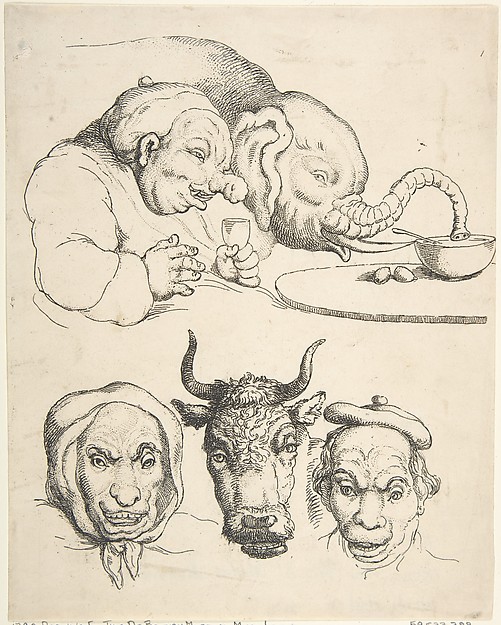 |
| Thomas Rowlandson, Comparative Anatomy |
This is what is
expressed in Lavater’s tables, in German derogatory terms (Schwein, Hund)—in the
affect of anger; or in terms of endearment—in the affect of love (pussycat,
bunny, etc.).
The epoch of the
figurative representation of beasts produces the transition from “eidetic”
naturalism to stylization by
plastically “metaphorizing” animal forms as twining… plants. Scheltema [in his
book] Altnordische Kunst writes about
the ornamental dissolution of animal into vegetative forms.
And finally, when people needed to form an image of a supra-human being, they made it in the shape
of a God-man! (After they had already “tried him out” in the animal and
vegetative shapes of the older divinities!)
***
Vegetative world,
entering the domain of pure form—becoming-ornamental—assumes a geometrical nature, i.e. it comes under the conditions of
crystalline regularity of the mineral type.
NB. Metaphorical
“anthropomorphizing” of plants and animals is not at all in contradiction with
this. In the given case it does not even rest on the play of reversibility
(i.e. on an omnipresent dialectical phenomenon). But rather on a phenomenon
related to a completely different branch of primitive (sensuous) thought: animization [animizatsiya].
 |
| Eisenstein's Drawing form his 1914 Sketchbook: anthropomorphizing of fish, "fishization" of bourgeois men |
And so two
phenomena, which appear merely as
dialectical opposites, in this case belong to two different realms within one
and the same domain.
However, mutual
reversibility exists here as well—not in
the case as such, but rather in the deep rhizomes of the very principles of
phenomena.
Indeed.
The line of the
intensification of the sensuous—of the sensuous effect (which is what “giving
form” is)—follows a visible descent.
Animization
is already the first step through animation to… spiritualization (“poetization”
in line with the “divinization” of nature, of animals, people, etc.).
And how beautiful
it is that the opposites—the forking paths—of the sensuous and the
spiritualized turn out as dialectically united in their cradle—in the single
womb of sensuous thought!

[From: Sergei Eisenstein, Metod, Vol. 2 (Moscow: Muzei kino, 2002), 383-4.]
[i]
Olivier-Beauregard, La Caricature Egyptienne Historique, Politique, Morale
(Paris: Thorin et Fils, 1894).

No comments:
Post a Comment